Intelligent Safety Monitoring
with Edge AI
MTechnology cameras process video analytics directly on-device. PPE compliance, perimeter protection, behavioral analysis and thermal monitoring run at the edge — no external servers, no additional software, no recurring license fees.
The intelligence is in the camera, not on a server
Traditional video analytics systems rely on server-side processing: cameras stream raw video to a central GPU server, which runs the analysis. More cameras mean more processing power — and more cost.
MTechnology takes a different approach. Every camera carries a dedicated AI processor that analyses the scene in real time, on-device. The NVR receives pre-processed events — not raw video to decode. Each camera you add brings its own computing power.
The result: zero GPU servers to purchase, sub-100ms alarm latency, and full functionality even during network outages. The system scales naturally from 10 to 200+ cameras without architectural changes.
FIELD                          CONTROL ROOM

AI Cameras ──┐                 NVR (AI engine)
 PPE detect   │                 ├── Local monitor
 Perimeter    ├── PoE Switch ── ├── Mobile app (push)
 Person/Veh.  │                 ├── HSE reports
              │                 ├── Alarm I/O
Thermal ──────┤                 └── Local storage
 Fire detect  │
              │                 [VMS] ← optional
I/O Sensors ──┘ visualization layerSix AI functions that run natively on MTechnology AI cameras (available functions depend on the model) — no plugins, no server-side processing, no third-party software required.

PPE Detection
Detects personal protective equipment in real time, directly on the camera: workwear, safety helmet, normal hat, no hat, face mask, apron, gloves, shoe covers, boots, safety harness and high-visibility vest. Safety helmet and workwear are also classified by colour, so different trades can be told apart on the same site. The alarm can be raised when the required equipment is missing, or only when everything matches.

Person & Vehicle Classification
Distinguishes people, vehicles and non-motorized vehicles from environmental noise — leaves, animals, shadows, rain, snow. The NVR receives only verified events, not generic motion alerts.

Perimeter & Restricted Areas
Directional tripwire, polygon intrusion zones, fast-moving detection and loitering alerts. Each rule filters by target type (person or vehicle), so a forklift crossing a line does not trigger a pedestrian alarm.

Behavioral Analysis
Detects running, falling, loitering and abnormal crowd formation. In ATEX-classified zones, smoking detection triggers an immediate alarm. Events are logged with timestamp, area and snapshot for post-incident review.

Thermal Monitoring & Fire Prevention
Bi-spectrum cameras (visible + thermal) detect hotspots before they become fires. Configurable temperature thresholds with pre-alarm and critical alarm levels. Emissivity calibration for industrial materials is essential for accurate readings.

ANPR & Vehicle Access
Automatic Number Plate Recognition with allowlist/blocklist matching. Authorized vehicles open barriers automatically; unauthorized plates trigger alerts with plate image, timestamp and direction. Integrates with access control and visitor management.
PPE detection runs on board our MT-IPB9104AI camera, with no analytics server and no recorder-side processing.
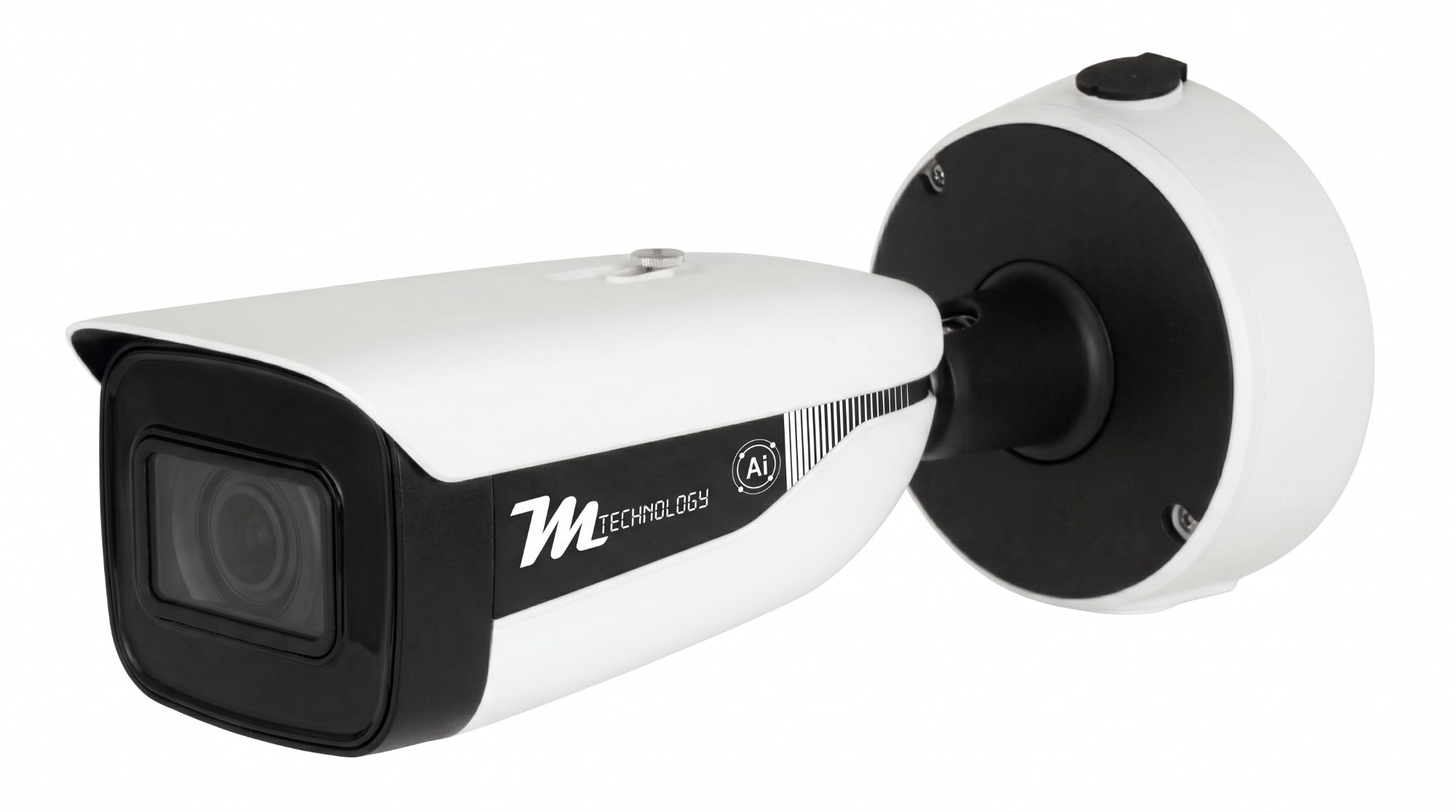
MT-IPB9104AI
4MP AI IR Bullet Network Camera · On-Board PPE Detection
The camera checks whether a person is wearing the required protective equipment and raises an alarm on match or on mismatch, according to the rule you configure.
MT-IPB9104AI technical datasheet, rev. A26.08
Why processing at the camera matters for industrial HSE deployments.
| Capability | Server-based approach | MTechnology Edge AI |
|---|---|---|
| Where AI runs | Central GPU server or cloud | Dedicated AI processor on each camera |
| PPE Detection | Requires third-party plugin + server license | Native — 9 PPE attributes, on-device |
| Alarm latency | 200–500ms (network + server queue) | <100ms (processed locally) |
| Scaling cost | More cameras = more GPU power needed | Each camera brings its own processing |
| GPU servers required | Yes (typically 1 per 30–50 channels) | None |
| Per-channel licenses | Yes (analytics + VMS) | None — all analytics included |
| Network dependency | Analytics stop if network fails | Full operation during network outages |
| VMS integration | Required for analytics to function | Optional — system is self-sufficient |
| Storage optimization | Standard H.265 | Smart H.265+ — up to 50% less storage |
Video surveillance in the workplace operates within a strict regulatory framework. MTechnology integrates privacy protection by design.
Real-Time Privacy Masking
Automatic face and body masking applied directly on-camera. AI analytics continue to function beneath the mask — PPE detection, people counting and perimeter protection all work on anonymized video. Control room operators see silhouettes, not identifiable individuals.
Controlled Decryption
In post-incident investigations, original unmasked footage can be accessed only with management-level authorization keys. This dual-layer approach supports data minimization principles while preserving the ability to review footage when legally justified.
GDPR Data Minimization
Privacy masking supports the GDPR principle of data minimization: the system collects only what is necessary for safety monitoring. Analytics metadata (event type, timestamp, zone) is processed without requiring personally identifiable visual data in normal operation.
Cybersecurity
AES-256 encrypted streams, HTTPS management, 802.1X network authentication, configurable multi-factor access. Firmware integrity checks and secure boot prevent tampering. No mandatory cloud connection — all data stays on local infrastructure.
Important: Where video surveillance may result in remote monitoring of work activity, applicable labor regulations (e.g. worker representation agreements or labor inspectorate authorization under EU member state laws) must be observed. A DPIA (Data Protection Impact Assessment) is recommended for all workplace deployments. Privacy masking is a technical measure supporting compliance — it does not replace the required legal and organizational safeguards.
Video surveillance in the workplace operates within a strict regulatory framework. MTechnology integrates privacy protection by design.
Real-Time Privacy Masking
Automatic face and body masking applied directly on-camera. AI analytics continue to function beneath the mask — PPE detection, people counting and perimeter protection all work on anonymized video. Control room operators see silhouettes, not identifiable individuals.
Controlled Decryption
In post-incident investigations, original unmasked footage can be accessed only with management-level authorization keys. This dual-layer approach supports data minimization principles while preserving the ability to review footage when legally justified.
GDPR Data Minimization
Privacy masking supports the GDPR principle of data minimization: the system collects only what is necessary for safety monitoring. Analytics metadata (event type, timestamp, zone) is processed without requiring personally identifiable visual data in normal operation.
Cybersecurity
AES-256 encrypted streams, HTTPS management, 802.1X network authentication, configurable multi-factor access. Firmware integrity checks and secure boot prevent tampering. No mandatory cloud connection — all data stays on local infrastructure.
Important: Where video surveillance may result in remote monitoring of work activity, applicable labor regulations (e.g. worker representation agreements or labor inspectorate authorization under EU member state laws) must be observed. A DPIA (Data Protection Impact Assessment) is recommended for all workplace deployments. Privacy masking is a technical measure supporting compliance — it does not replace the required legal and organizational safeguards.
AI Edge Analytics for Industrial Safety & HSE
Our comprehensive white paper covers the full MTechnology AI ecosystem: PPE detection, behavioral analysis, thermal monitoring, ANPR, privacy compliance, cybersecurity and pilot deployment methodology.